
PDF Publication Title:
Text from PDF Page: 077
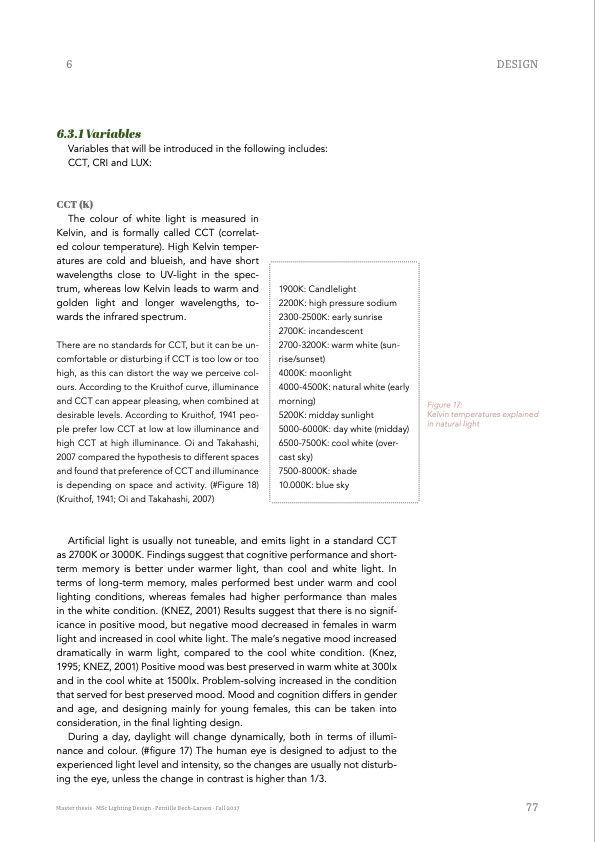
6 DESIGN 6.3.1 Variables Variables that will be introduced in the following includes: CCT, CRI and LUX: CCT (K) The colour of white light is measured in Kelvin, and is formally called CCT (correlat- ed colour temperature). High Kelvin temper- atures are cold and blueish, and have short wavelengths close to UV-light in the spec- trum, whereas low Kelvin leads to warm and golden light and longer wavelengths, to- wards the infrared spectrum. There are no standards for CCT, but it can be un- comfortable or disturbing if CCT is too low or too high, as this can distort the way we perceive col- ours. According to the Kruithof curve, illuminance and CCT can appear pleasing, when combined at desirable levels. According to Kruithof, 1941 peo- ple prefer low CCT at low at low illuminance and high CCT at high illuminance. Oi and Takahashi, 2007 compared the hypothesis to different spaces and found that preference of CCT and illuminance is depending on space and activity. (#Figure 18) (Kruithof, 1941; Oi and Takahashi, 2007) Artificial light is usually not tuneable, and emits light in a standard CCT as 2700K or 3000K. Findings suggest that cognitive performance and short- term memory is better under warmer light, than cool and white light. In terms of long-term memory, males performed best under warm and cool lighting conditions, whereas females had higher performance than males in the white condition. (KNEZ, 2001) Results suggest that there is no signif- icance in positive mood, but negative mood decreased in females in warm light and increased in cool white light. The male’s negative mood increased dramatically in warm light, compared to the cool white condition. (Knez, 1995; KNEZ, 2001) Positive mood was best preserved in warm white at 300lx and in the cool white at 1500lx. Problem-solving increased in the condition that served for best preserved mood. Mood and cognition differs in gender and age, and designing mainly for young females, this can be taken into consideration, in the final lighting design. During a day, daylight will change dynamically, both in terms of illumi- nance and colour. (#figure 17) The human eye is designed to adjust to the experienced light level and intensity, so the changes are usually not disturb- ing the eye, unless the change in contrast is higher than 1/3. Figure 17: Kelvin temperatures explained in natural light 1900K: Candlelight 2200K: high pressure sodium 2300-2500K: early sunrise 2700K: incandescent 2700-3200K: warm white (sun- rise/sunset) 4000K: moonlight 4000-4500K: natural white (early morning) 5200K: midday sunlight 5000-6000K: day white (midday) 6500-7500K: cool white (over- cast sky) 7500-8000K: shade 10.000K: blue sky Master thesis · MSc Lighting Design · Pernille Bech-Larsen · Fall 2017 77PDF Image | Healing with light
PDF Search Title:
Healing with lightOriginal File Name Searched:
THESIS_200118_PBL_FINAL.pdfDIY PDF Search: Google It | Yahoo | Bing
Cruise Ship Reviews | Luxury Resort | Jet | Yacht | and Travel Tech More Info
Cruising Review Topics and Articles More Info
Software based on Filemaker for the travel industry More Info
The Burgenstock Resort: Reviews on CruisingReview website... More Info
Resort Reviews: World Class resorts... More Info
The Riffelalp Resort: Reviews on CruisingReview website... More Info
| CONTACT TEL: 608-238-6001 Email: greg@cruisingreview.com | RSS | AMP |