PDF Publication Title:
Text from PDF Page: 119
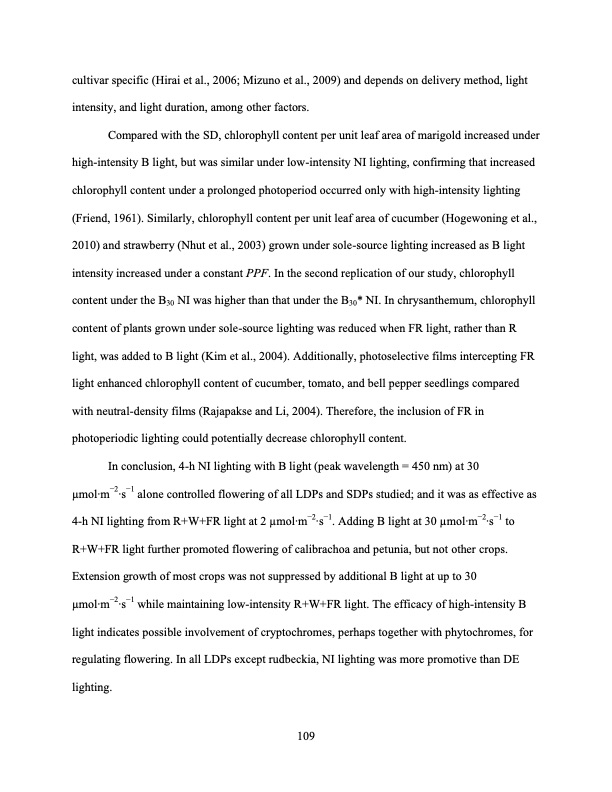
cultivar specific (Hirai et al., 2006; Mizuno et al., 2009) and depends on delivery method, light intensity, and light duration, among other factors. Compared with the SD, chlorophyll content per unit leaf area of marigold increased under high-intensity B light, but was similar under low-intensity NI lighting, confirming that increased chlorophyll content under a prolonged photoperiod occurred only with high-intensity lighting (Friend, 1961). Similarly, chlorophyll content per unit leaf area of cucumber (Hogewoning et al., 2010) and strawberry (Nhut et al., 2003) grown under sole-source lighting increased as B light intensity increased under a constant PPF. In the second replication of our study, chlorophyll content under the B30 NI was higher than that under the B30* NI. In chrysanthemum, chlorophyll content of plants grown under sole-source lighting was reduced when FR light, rather than R light, was added to B light (Kim et al., 2004). Additionally, photoselective films intercepting FR light enhanced chlorophyll content of cucumber, tomato, and bell pepper seedlings compared with neutral-density films (Rajapakse and Li, 2004). Therefore, the inclusion of FR in photoperiodic lighting could potentially decrease chlorophyll content. In conclusion, 4-h NI lighting with B light (peak wavelength = 450 nm) at 30 μmol∙m−2∙s−1 alone controlled flowering of all LDPs and SDPs studied; and it was as effective as 4-h NI lighting from R+W+FR light at 2 μmol∙m−2∙s−1. Adding B light at 30 μmol∙m−2∙s−1 to R+W+FR light further promoted flowering of calibrachoa and petunia, but not other crops. Extension growth of most crops was not suppressed by additional B light at up to 30 μmol∙m−2∙s−1 while maintaining low-intensity R+W+FR light. The efficacy of high-intensity B light indicates possible involvement of cryptochromes, perhaps together with phytochromes, for regulating flowering. In all LDPs except rudbeckia, NI lighting was more promotive than DE lighting. 109PDF Image | LED REGULATE FLOWERING OF PHOTOPERIODIC ORNAMENTAL CROPS
PDF Search Title:
LED REGULATE FLOWERING OF PHOTOPERIODIC ORNAMENTAL CROPSOriginal File Name Searched:
Meng_grad-msu_0128N_12984.pdfDIY PDF Search: Google It | Yahoo | Bing
Cruise Ship Reviews | Luxury Resort | Jet | Yacht | and Travel Tech More Info
Cruising Review Topics and Articles More Info
Software based on Filemaker for the travel industry More Info
The Burgenstock Resort: Reviews on CruisingReview website... More Info
Resort Reviews: World Class resorts... More Info
The Riffelalp Resort: Reviews on CruisingReview website... More Info
| CONTACT TEL: 608-238-6001 Email: greg@cruisingreview.com | RSS | AMP |